Avatar Technology - Best for Engineering

Avatar Technology is the Best Platform to run the topic about Engineering.and any other technical things to improve your skills.

Showing posts with label SIGNAL SYSTEM. Show all posts

Friday, July 24, 2020

Static Linearity and Sinusoidal Fidelity

Static Linearity and Sinusoidal Fidelity:-

Homogeneity, additivity, and move invariance are significant in light of the fact that they give the numerical premise to characterizing direct frameworks. Shockingly, these properties alone don't furnish most researchers and architects with an instinctive sentiment of what straight frameworks are about. The properties of static linearity and sinusoidal devotion are frequently of help here. These are not particularly significant from a scientific point of view, however identify with how people consider and comprehend straight frameworks. You should give exceptional consideration to this area. 

Static linearity characterizes how a direct framework responds when the signs aren't evolving, i.e., when they are DC or static. The static reaction of a straight framework is basic: the yield is the information duplicated by a consistent. That is, a diagram of the conceivable information esteems plotted against the relating yield esteems is a straight line that goes through the root. This is appeared in Fig. 5-5 for two normal direct frameworks: Ohm's law for resistors, and Hooke's law for springs. For examination, Fig. 5-6 shows the static relationship for two nonlinear frameworks: a pn intersection diode, and the attractive properties of iron.


Every single straight framework have the property of static linearity. The inverse is normally obvious, yet not generally. There are frameworks that show static linearity, yet are not direct as for evolving signals. Be that as it may, a typical class of frameworks can be totally comprehended with static linearity alone. In these frameworks it doesn't make a difference if the info signal is static or evolving. These are called memoryless frameworks, on the grounds that the yield relies just upon the current situation with the information, and not on its history. For instance, the prompt current in a resistor relies just upon the quick voltage across it, and not on how the signs came to be the worth they are. On the off chance that a framework has static linearity, and is memoryless, at that point the framework must be straight. This gives a significant method to comprehend (and demonstrate) the linearity of these basic frameworks.


A significant quality of direct frameworks is the manner by which they carry on with sinusoids, a property we will call sinusoidal devotion: If the contribution to a straight framework is a sinusoidal wave, the yield will likewise be a sinusoidal wave, and at the very same recurrence as the info. Sinusoids are the main waveform that have this property. For example, there is no motivation to expect that a square wave entering a direct framework will create a square wave on the yield. Albeit a sinusoid on the information ensures a sinusoid on the yield, the two might be diverse in abundancy and stage. This ought to be natural from your insight into gadgets: a circuit can be depicted by its recurrence reaction, charts of how the circuit's benefit and stage shift with recurrence. 

Presently for the converse inquiry: If a framework consistently delivers a sinusoidal yield because of a sinusoidal info, is the framework destined to be direct? The appropriate response is no, however the exemptions are uncommon and generally self-evident. For instance, envision a detestable evil spirit stowing away inside a framework, with the objective of attempting to delude you. The devil has an oscilloscope to watch the information signal, and a sine wave generator to deliver a yield signal. At the point when you feed a sine wave into the information, the evil spirit rapidly quantifies the recurrence and alters his sign generator to deliver a relating yield. Obviously, this framework isn't straight, since it isn't added substance. To show this, place the total of two sine waves into the framework. The evil spirit can just react with a solitary sine wave for the yield. This model isn't as thought up as you may might suspect; stage lock circles work in much along these lines. 

To show signs of improvement feeling for linearity, consider an expert attempting to decide whether an electronic gadget is direct. The expert would append a sine wave generator to the contribution of the gadget, and an oscilloscope to the yield. With a sine wave input, the expert would hope to check whether the yield is additionally a sine wave. For instance, the yield can't be cut on the top or base, the top half can't appear to be unique from the base half, there must be no mutilation where the sign crosses zero, and so on. Next, the expert would shift the adequacy of the information and watch the impact on the yield signal. In the event that the framework is direct, the plentifulness of the yield must track the adequacy of the info. In conclusion, the specialist would differ the info sign's recurrence, and check that the yield sign's recurrence changes as needs be. As the recurrence is changed, there will probably be sufficiency and stage changes found in the yield, yet these are totally passable in a straight framework. At certain frequencies, the yield may even be zero, that is, a sinusoid with zero adequacy. In the event that the specialist sees every one of these things, he will presume that the framework is direct. While this decision is certifiably not a thorough numerical evidence, the degree of certainty is reasonably high.


 Topic Wise Chappter here:-


Thursday, July 23, 2020

Special Properties of Linearity

Special Properties of Linearity

Linearity is commutative, a property including the blend of at least two frameworks. Figure 5-10 shows the general thought. Envision two frameworks joined in a course, that is, the yield of one framework is the contribution to the following. On the off chance that every framework is direct, at that point the general mix will likewise be straight.


 The commutative property expresses that the request for the frameworks in the course can be revised without influencing the attributes of the general mix. You likely have utilized this guideline in electronic circuits. For instance, envision a circuit made out of two phases, one for enhancement, and one for separating. Which is ideal, enhance and afterward channel, or channel and afterward intensify? On the off chance that the two phases are direct, the request doesn't have any effect and the general outcome is the equivalent. Remember that genuine hardware has nonlinear impacts that may make the request significant, for example: impedance, DC balances, inside clamor, slew rate bending, and so on.


Figure 5-8 shows the subsequent stage in straight framework hypothesis: numerous information sources and yields. A framework with numerous sources of info and additionally yields will be straight on the off chance that it is made out of direct subsystems and options of signs. The multifaceted nature doesn't make a difference, just that nothing nonlinear is permitted within the framework. 

To comprehend what linearity implies for frameworks with numerous data sources as well as yields, consider the accompanying psychological study. Start by putting a sign on one information while different data sources are held at zero.

 This will make the numerous yields react with some example of signs. Next, rehash the technique by putting another sign on an alternate information. Similarly as in the past, keep the entirety of different contributions at zero. 

This subsequent information sign will bring about another example of signs showing up on the various yields. To complete the trial, place the two signs on their separate data sources at the same time.

 The signs showing up on the yields will basically be the superposition (aggregate) of the yield signals delivered when the info signals were applied independently.


The utilization of increase in straight frameworks is every now and again misjudged. This is on the grounds that augmentation can be either straight or nonlinear, contingent upon what the sign is duplicated by. Figure 5-9 outlines the two cases. A framework that duplicates the info signal by a consistent, is direct.

 This framework is an enhancer or an attenuator, depending if the consistent is more prominent or short of what one, separately. Interestingly, increasing a sign by another sign is nonlinear. Envision a sinusoid increased by another sinusoid; the subsequent waveform is plainly not sinusoidal. 

Another generally misjudged circumstance identifies with parasitic signs included hardware, for example, DC counterbalances and warm commotion. Is the expansion of these superfluous signs straight or nonlinear?

 The appropriate response relies upon where the tainting signals are seen as starting. In the event that they are seen as originating from inside the framework, the procedure is nonlinear.


This is on the grounds that a sinusoidal information doesn't deliver an unadulterated sinusoidal yield. Alternately, the incidental sign can be seen as remotely entering the framework on a different contribution of a numerous info framework. 

This makes the procedure straight, since just a sign expansion is required inside the framework.


Wednesday, July 22, 2020

Requirements for Linearity

Requirements of Linearity

A framework is called direct on the off chance that it has two scientific properties: homogeneity and additivity. In the event that you can show that a framework has the two properties, at that point you have demonstrated that the framework is direct. In like manner, in the event that you can show that a framework doesn't have one or the two properties, you have demonstrated that it isn't direct. A third property, move invariance, is definitely not a severe prerequisite for linearity, however it is an obligatory property for most DSP procedures. At the point when you see the term direct framework utilized in DSP, you ought to accept it incorporates move invariance except if you have motivation to accept something else. These three properties structure the science of how direct framework hypothesis is characterized and utilized. Later in this section we will take a gander at increasingly natural methods of getting linearity. Until further notice, how about we experience these formal scientific properties.

As represented in Fig.(5.1) homogeneity implies that an adjustment in the info sign's sufficiency brings about a relating change in the yield sign's adequacy. In scientific terms, if an information sign of x[n] brings about a yield sign of y[n], a contribution of kx[n] brings about a yield of ky[n], for any info sign and steady, k.


A straightforward resistor gives a genuine case of both homogenous and non-homogeneous frameworks. In the event that the contribution to the framework is the voltage over the resistor, v(t), and the yield from the framework is the current through the resistor, i(t) , the framework is homogeneous. Ohm's law ensures this; if the voltage is expanded or diminished, there will be a relating increment or abatement in the current. Presently, consider another framework where the info signal is the voltage over the resistor, v(t), yet the yield signal is the force being scattered in the resistor, p(t). Since power is relative to the square of the voltage, if the info signal is expanded by a factor of two, the yield signal is increment by a factor of four. This framework isn't homogeneous and accordingly can't be straight. 

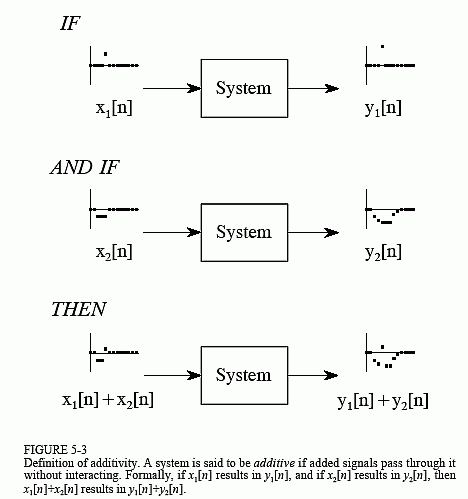
The property of additivity is delineated in Fig. 5-3. Consider a framework where a contribution of x1[n] produces a yield of y1[n]. Further guess that an alternate information, x2[n], produces another yield, y2[n]. The framework is supposed to be added substance, if a contribution of x1[n] + x2[n] brings about a yield of y1[n] + y2[n], for all conceivable information signals. In words, signals included at the information produce flags that are included at the yield.


The significant point is that additional signs go through the framework without associating. For instance, consider a phone discussion with your Aunt Edna and Uncle Bernie. Auntie Edna starts a somewhat extensive tale about how well her radishes are getting along this year. Out of sight, Uncle Bernie is shouting at the canine for having a mishap in his preferred seat. The two voice signals are included and electronically transmitted through the phone organize. Since this framework is added substance, the sound you hear is the total of the two voices as they would sound whenever transmitted independently. You hear Edna and Bernie, not the animal, Ednabernie. 

A genuine case of a nonadditive circuit is the blender stage in a radio transmitter. Two signs are available: a sound sign that contains the voice or music, and a transporter wave that can spread through space when applied to a reception apparatus. The two signs are added and applied to a nonlinearity, for example, a pn intersection diode. This outcomes in the signs converging to frame a third sign, a tweaked radio wave equipped for conveying the data over significant stretches. 

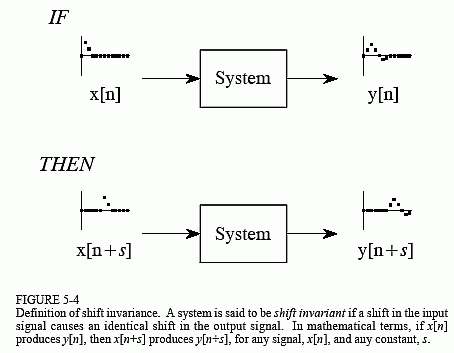
As appeared in Fig. 5.4, move invariance implies that a move in the info sign will bring about simply an indistinguishable move in the yield signal. In progressively formal terms, if an information sign of x[n] brings about a yield of y[n], an information sign of x[n + s] brings about a yield of y[n + s], for any information signal and any steady, s. Pay specific notification to how the science of this move is composed, it will be utilized in up and coming sections. By including a steady, s, to the free factor, n, the waveform can be progressed or hindered in the flat course. For instance, when s = 2, the sign is moved left by two examples; when s = - 2, the sign is moved right by two examples.


Move invariance is significant in light of the fact that it implies the attributes of the framework don't change with time (or whatever the free factor happens to be). On the off chance that a blip in the info causes a blop in the yield, you can be guaranteed that another blip will cause an indistinguishable blop. The greater part of the frameworks you experience will be move invariant. This is blessed, in light of the fact that it is hard to manage frameworks that change their qualities while in activity. For instance, envision that you have planned a computerized channel to make up for the corrupting impacts of a phone transmission line. Your channel makes the voices sound increasingly characteristic and more clear. Causing you a deep sense of shock, along comes winter and you discover the qualities of the phone line have changed with temperature. Your pay channel is presently jumbled and doesn't work particularly well. This circumstance may require a progressively modern calculation that can adjust to evolving conditions. 

For what reason do homogeneity and additivity assume a basic job in linearity, while move invariance is something as an afterthought? This is on the grounds that linearity is an extremely wide idea, enveloping considerably more than just signals and frameworks. For instance, consider a rancher selling oranges for $2 per box and apples for $5 per container. In the event that the rancher sells just oranges, he will get $20 for 10 boxes, and $40 for 20 containers, making the trade homogenous. On the off chance that he sells 20 cartons of oranges and 10 containers of apples, the rancher will get: . This is a similar sum as though the two had been sold independently, making the exchange added substance. Being both homogenous and added substance, this offer of merchandise is a straight procedure. Be that as it may, since there are no signs included, this isn't a framework, and move invariance has no importance. Move invariance can be thought of as an extra part of linearity required when signs and frameworks are included.


INTRODUCTION TO SIGNAL SYSTEM

Signals and System

A sign is a depiction of how one boundary differs with another boundary. For example, voltage changing after some time in an electronic circuit, or splendor fluctuating with separation in a picture. A framework is any procedure that creates a yield signal because of an info signal. This is represented by the square graph in Fig. Constant frameworks info and yield persistent signs, for example, in simple hardware. Discrete frameworks information and yield discrete signs, for example, PC programs that control the qualities put away in exhibits. 

A few guidelines are utilized for naming signs. These aren't constantly followed in DSP, however they are normal and you ought to retain them. The arithmetic is troublesome enough without an unmistakable documentation. Initially, nonstop signals use enclosures, for example, x(t) and y(t), while discrete signs use sections, as in: x[n] and y[n]. Second, signals use lower case letters. Capitalized letters are saved for the recurrence space, talked about in later sections. Third, the name given to a sign is typically illustrative of the boundaries it speaks to. For instance, a voltage relying upon time may be called: v(t), or a financial exchange cost estimated every day could be.


Signs and frameworks are every now and again examined without realizing the specific boundaries being spoken to. This is equivalent to utilizing x and y in polynomial math, without relegating a physical significance to the factors. This acquires a fourth standard for naming signs. On the off chance that a progressively elucidating name isn't accessible, the information sign to a discrete framework is generally called: x[n], and the yield signal: y[n]. For consistent frameworks, the signs: x(t) and y(t) are utilized. 

There are numerous explanations behind needing to comprehend a framework. For instance, you might need to structure a framework to expel clamor in an electrocardiogram, hone an out-of-center picture, or evacuate echoes in a sound chronicle. In different cases, the framework may have a mutilation or meddling impact that you have to portray or gauge. For example, when you talk into a phone, you anticipate that the other individual should hear something that looks like your voice. Shockingly, the info sign to a transmission line is only from time to time indistinguishable from the yield signal. On the off chance that you see how the transmission line (the framework) is changing the sign, perhaps you can make up for its impact. In still different cases, the framework may speak to some physical procedure that you need to examine or break down. Radar and sonar are genuine instances of this. These techniques work by contrasting the transmitted and reflected signs with discover the qualities of a far off article. As far as framework hypothesis, the issue is to discover the framework that changes the transmitted sign into the got signal. 

From the outset, it might appear to be a mind-boggling errand to see the entirety of the potential frameworks on the planet. Luckily, most valuable frameworks fall into a class called direct frameworks. This reality is critical. Without the straight framework idea, we would be compelled to look at the individual attributes of numerous disconnected frameworks. With this methodology, we can concentrate on the characteristics of the direct framework class all in all. Our first undertaking is to recognize what properties make a framework direct, and how they fit into the ordinary idea of hardware, programming, and other sign handling frameworks.