Avatar Technology - Best for Engineering

Avatar Technology is the Best Platform to run the topic about Engineering.and any other technical things to improve your skills.

Showing posts with label MACHINE. Show all posts

Thursday, July 30, 2020

Shaded Pole Induction Motor

Definition: The concealed shaft enlistment engine is just a self-beginning single-stage acceptance engine whose one of the post is concealed by the copper ring. The copper ring is likewise called the concealed ring. This copper ring go about as an optional twisting for the engine. The concealed post engine turns just one specific way, and the converse development of the engine is unimaginable. 


Why the Shaded Pole Induction Motor structures for low force rating? 


The force misfortunes are high in the concealed post enlistment engine. What's more, the force factor of the engine is low. The beginning force actuates in the acceptance engine are likewise low. Due to the accompanying reasons the engine has helpless effectiveness. Subsequently, their plans are kept little, and the engine has low force appraisals. 


Development of Shaded Pole Induction Motor 


The concealed shaft engine may have two or four posts. Here in this article, we utilize the two shaft engine for effortlessness. The speed of the engine is conversely relative to the quantity of shafts utilized in the engine. 


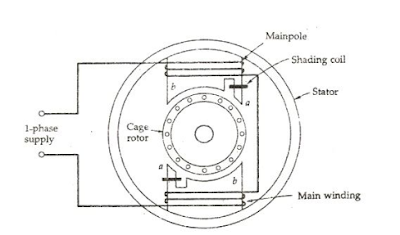
Stator – The stator of the concealed post engine has a notable shaft. The notable shaft implies the posts of the magnet are anticipated towards the armature of the engine. Each shaft of the engine is energized by its energizing curl. The copper rings conceal the circles. The circles are known as the concealing loop. 


The posts of the engine are overlaid. The overlay implies different layers of material are utilized for making the shafts. Along these lines, that the quality of the shaft increments. 


The space is developed at some separation separated from the edge of the shafts. The shortcircuited copper curl is set in this opening. The part which is secured with the copper ring is known as the concealed part and which are not secured by the rings are called unshaded part. 


Rotor – The concealed shaft engine utilizes the squirrel confine rotor. The bars of the rotor is slanted at a point of 60º. The slant should be possible for getting the better beginning force. 


The development of the engine is exceptionally straightforward in light of the fact that it doesn't contain any commutator, brushes, gatherer rings, and so on or some other part. The concealed shaft acceptance engine doesn't have any outward switch. Along these lines, the odds of disappointment of the engine are less. 


The outward switch is the sort of electrical switch that starts working by utilizing the divergent power, produced by the pivoting shaft. It is additionally utilized for controlling the speed of the pole. 


shaded Pole Induction Motor Working 


At the point when the flexibly is associated with the windings of the rotor, the substituting transition instigates in the center of the rotor. The little part of the motion connect with the concealed loop of the engine as in light of the fact that it is shortcircuited. The variety in the transition prompts the voltage inside the ring in view of which the flowing current incites in it. 


The coursing current builds up the transition in the ring which restricts the primary motion of the engine. The transition initiates in the concealed part of the engine, i.e., an and the unshaded segment of the engine, i.e., b have a stage contrast. The fundamental engine transition and the concealed ring motion are additionally having a space dislodging by a point of 90°. 


The association chart of the Shaded Pole Motor is demonstrated as follows. 


As there is existence relocation between the two transitions, the turning attractive field actuates in the curl. The pivoting attractive field builds up the beginning force in the engine. The field pivots from the unshaded segment to the concealed part of the engine. 


Uses of the Shaded Pole Induction Motor 


The different uses of the Shaded Poles Motor are as per the following:- 

  • They are appropriate for little gadgets like transfers and fans in light of its minimal effort and simple beginning. 

  • Utilized in exhaust fans, hair dryers and furthermore in table fans. 

  • Utilized in cooling and refrigeration gear and cooling fans. 

  • Phonographs, recording devices, projectors, copying machines. 

  • Utilized for beginning electronic tickers and single-stage simultaneous planning engines. 

  • This sort of engine is utilized to drive the gadgets which require low beginning force.


Wednesday, July 29, 2020

Applications of Induction Motor

The Polyphase Induction Motor is an engine whose stator contains various windings. They are more prominent than one torque or one kilowatt. The National Electrical Manufacturers Association (NEMA) has indicated the engines as per the different Class, which are talked about beneath in detail. There are different utilizations of Polyphase injury rotor acceptance engines, Polyphase confine enlistment engines. They are as per the following: 


Utilizations of Polyphase Wound Rotor Induction Motors 


Wound rotor engines are reasonable for loads requiring high beginning force and where a lower beginning current is required. 


The Wound rotor enlistment engines are likewise utilized for loads having high dormancy, which brings about higher vitality misfortunes. 


Utilized for the heaps which require a slow development of force. 


Utilized for the heaps that require speed control. 


The injury rotor enlistment engines are utilized in transports, cranes, siphons, lifts and blowers. 


The greatest force is over 200 percent of the full burden esteem while the full burden slip might be as low as 3 percent. The proficiency is around 90 %. 


Utilizations of Polyphase Cage Rotor Induction Motors 


Numerous polyphase confine enlistment engines are accessible in the market to fulfill the need of the few mechanical applications and different beginning and running condition necessity. They are ordered by the Class. 


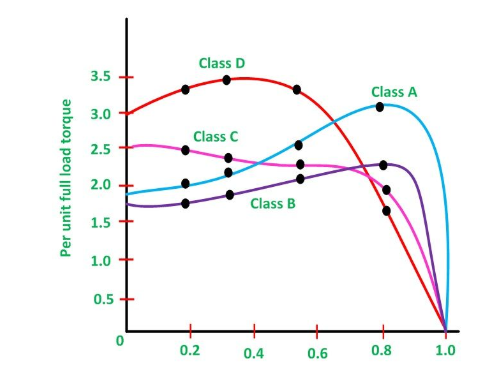
The speed force qualities of Cage Induction Motor of different Classes are demonstrated as follows. 


Class A Motors 


Class An engines have typical beginning force, high beginning current and low working slip (0.005-0.015). The structure has low opposition single enclosure rotor. The productivity of the engine is high at full burden. Uses of Class An engines are fans, blowers, divergent siphons, and so forth. 


Class B Motors 


Class B engines have ordinary beginning force, low beginning current and low beginning current and low working slip. The engine is structured, in such an approach to withstand the high spillage reactance, therefore, the beginning current is diminished. The beginning force is kept up by utilization of a twofold enclosure or profound bar rotor. 


The Class B engines are most regularly utilized engine and utilized for full voltage beginning. The applications and the beginning force are same as that of Class An engines. 


Class C Motors 


The class C engines have high beginning force and low beginning current. Such engines are of the twofold pen and profound bar and has higher rotor opposition. The heaps are blowers, transports, responding siphons, smashers, and so forth. 


Class D Motors 


Class D engines have the most elevated beginning force when contrasted with the various class of engines. The bars of the rotor confine are comprised of metal. These sorts of engines have low beginning current and high working slip. The estimation of full burden working slip changes between 8 to 15%. In this way, the productivity of the engine is low. 


These engines are reasonable for driving discontinuous burdens which require visit speeding up and high loads. For instance – punch presses, pieces of machinery and kick the bucket stepping machines. At the point when the engine is driving the high effect loads, it is coupled to a flywheel to give active vitality.


Capacitor Start Induction Motor

A Capacitor Start Motors are a solitary stage Induction Motor that utilizes a capacitor in the helper twisting circuit to deliver a more prominent stage contrast between the current in the fundamental and the assistant windings. The name capacitor begins itself shows that the engine utilizes a capacitor with the end goal of the beginning. The figure underneath shows the association outline of a Capacitor Start Motor. 


Content: 

  • Phasor Diagram 

  • Qualities of the Capacitor Start Motor 

  • Utilizations of the Capacitor Start Motor 


The capacitor turn over engine has a pen rotor and has two windings on the stator. They are known as the principle winding and the assistant or the beginning winding. The two windings are set 90 degrees separated. A capacitor CS is associated in arrangement with the beginning winding. A radiating switch SC is additionally associated in the circuit. 


The Phasor Diagram of the Capacitor Start engine is demonstrated as follows. 


IM is the current in the fundamental winding which is slacking the assistant current IA by 90 degrees as appeared in the phasor outline above. Therefore, a solitary stage flexibly current is part into two stages. The two windings are uprooted separated by 90 degrees electrical, and their MMF's are equivalent in size yet 90 degrees separated in time stage. 


The engine goes about as a reasonable two-stage engine. As the engine moves toward its appraised speed, the helper winding and the beginning capacitor is disengaged consequently by the radial switch gave on the pole of the engine. 


Attributes of the Capacitor Start Motor 


The capacitor turns over engine builds up an a lot higher beginning force of around 3 to 4.5 occasions of the full burden force. To get a high beginning force, the two conditions are fundamental. They are as per the following:- 


The Starting capacitor esteem must be huge. 


The valve of the beginning winding opposition must be low. 


The electrolytic capacitors of the request for the 250 µF are utilized due to the high Var rating of the capacitor prerequisite. 


The Torque Speed Characteristic of the engine is demonstrated as follows. 


The trademark shows that the beginning force is high. The expense of this engine is more when contrasted with the split stage engine on account of the extra expense of the capacitor. The Capacitor turn over engine can be switched by first carrying the engine to rest condition and afterward turning around the associations of one of the windings. 


Uses of the Capacitor Start Motor 

The different uses of the engine are as per the following:- 

These engines are utilized for the heaps of higher inactivity where continuous beginning is required. 

Utilized in siphons and blowers 

Utilized in the cooler and climate control system blowers. 

They are additionally utilized for transports and machine instruments.

Capacitor Start Capacitor Run Motor

The Capacitor Run Motor Capacitor Start has a cage rotor, and its stator has two windings known as Main and Auxiliary Windings..The two windings are uprooted 90 degrees in space. There are two capacitors in this technique one is utilized at the hour of the beginning and is known as beginning capacitor. The other one is utilized for ceaseless running of the engine and is known as RUN capacitor. 


So this engine is named as Capacitor Start Capacitor Run Motor. This engine is otherwise called Two Value Capacitor Motor. Association graph of the Two valve Capacitor Motor is demonstrated as follows 


There are two capacitors in this engine spoke to by CS and CR. At the beginning, the two capacitors are associated in equal. The Capacitor Cs is the Starting capacitor is brief timeframe appraised. It is practically electrolytic. A lot of current id required to get the beginning force. Along these lines, the estimation of the capacitive reactance X ought to be low in the beginning winding. Since, XA = 1/2Ï€fCA, the estimation of the beginning capacitor ought to be huge. 


The appraised line current is littler than the beginning current at the typical working state of the engine. Subsequently, the estimation of the capacitive reactance ought to be enormous. Since, XR = 1/2Ï€fCR, the estimation of the run capacitor ought to be little 


As the engine arrives at the coordinated speed, the beginning capacitor Cs is separated from the circuit by a radial switch Sc. The capacitor CR is associated forever in the circuit and along these lines it is known as RUN Capacitor. The run capacitor is long time evaluated and is made of oil filled paper. 


The figure beneath shows the Phasor Diagram of the Capacitor Start Capacitor Run Motor.


Fig(a) shows the phasor chart when at the beginning both the capacitor are in the circuit and Ï• > 90⁰.


 Fig (b) shows the phasor when the beginning capacitor is detached, and Ï• gets equivalent to 90⁰. 


The Torque Speed Characteristic of a Two Value Capacitor Motor is demonstrated as follows. 


This kind of engine is tranquil and smooth running. They have higher proficiency than the engines that sudden spike in demand for the principle windings as it were. They are utilized for heaps of higher idleness requiring successive beginnings where the most extreme draw out force and proficiency required are higher. The Two Value Capacitor Motors are utilized in siphoning hardware, refrigeration, air blowers, and so forth.


Induction Motor

Induction Motor or machines are likewise called as Asynchronous Machine. The word Asynchronous implies that the machine never runs at coordinated speed. Acceptance engines are for the most part of two sorts. It tends to be single stage or three stage acceptance engines. 


Single stage enlistment engine is generally worked in little size (up to 3 H.P). The three-stage acceptance engines are the most generally utilized AC engines in the business. They are straightforward in development, dependable. It has ease, high proficiency, sensibly great force factor, dependable, self-beginning force and low support. Practically over 90% of the mechanical vitality utilized in the business is given by three stage acceptance engines. 


Three stage enlistment engines are chiefly utilized in the business for power transformation, i.e., electrical to mechanical force change in mass or huge amount. Be that as it may, for little force transformation single stage enlistment engines are utilized. The acceptance engines play out an assortment of administrations in the home, office, business, plants, and so forth. 


In all the residential apparatuses, for example, coolers, fans, clothes washers, hair dryers, blender processor, and so on., single stage enlistment engine are utilized.


DC Machine

A DC Machine is an electro-mechanical vitality transformation gadget. There are two kinds of DC machines; one is the DC generator, and another is known as DC engine


A DC generator changes over mechanical force (ωT) into DC electrical force (EI), though, a DC engine changes over d.c electrical force into mechanical force. The AC engine is perpetually applied in the business for change of electrical force into mechanical force, however at the spots where the wide scope of paces and great speed guideline is required, as in electric foothold framework, a DC engine is utilized. 


The development of the dc engine and generator is about the equivalent. The generator is utilized in an ensured manner. Subsequently there is an open development type. Yet, the engine is utilized in the area where they are presented to residue and dampness, and subsequently it requires fenced in areas for instance soil verification, flame resistant, and so on as indicated by necessity. 


Despite the fact that the battery is a significant wellspring of DC electric force, it can just gracefully constrained capacity to any machines. There are a few applications where enormous amounts of DC power are required, for example, electroplating, electrolysis, and so forth. Henceforth, at such places, DC generators are utilized to convey power. 


Fundamental Structure of Electrical Machines 


The turning electrical or DC machine has for the most part two sections; one is Stator, and another is Rotar. The stator and rotor are isolated from one another by an air hole. The stator is the external edge of the machine and is ardent. The rotor is allowed to move and is the internal piece of the machine.
 

 Openings are cut on the inward outskirts of the stator and the external fringe of the rotor. Conductors are put in the spaces of the stator or rotor. They are interconnected to frame windings. 


The windings wherein voltage is actuated is known as the Armature windings. The twisting through which a current is passed to create the fundamental motion is known as the Field windings. To give primary motion in a portion of the machine lasting magnets is likewise utilized. 


Equal Circuit of a DC Machine Armature 


The armature of a DC generator can be spoken to by an equal electrical circuit. It very well may be spoken to by three arrangement associated components E, Ra and Vb. 


The equal circuit of the armature of a DC generator is appeared underneath in the figure:


The equivalent circuit of the armature of a DC motor is shown below in the figure:


The element E in the equivalent circuit diagrams is the generated voltage, Ra is the armature resistance, and Vb is the brush contact voltage drop.


Difference between Induction Motor and Synchronous Motor


Difference Between Induction and Synchronous Motor is clarified with the assistance of different variables, similar to the sort of excitation utilized for the machine. The Speed of the engine, beginning and activity, the effectiveness of both the engines, its cost, utilization, and applications. recurrence. 


An Induction Motor is otherwise called Asynchronous Motor. It is purported in light of the fact that it never runs at coordinated speed. i.e., Ns = 120f/P. The acceptance engine is most broadly utilized engine in all local and business engine. The Synchronous engine consistently follows a coordinated speed. The speed of the rotor is kept up or synchronized with the flexibly current 


Distinction between Three Phase Induction Motor and Synchronous Motor 


  • A three stage Synchronous engine is a doubly energized machine, while an enlistment engine is a solitary energized machine. 


  • The armature twisting of the Synchronous engine is stimulated from an AC source and its field twisting from a DC source. The stator twisting of Induction Motor is stimulated from an AC source. 


  • Coordinated Motor consistently runs at simultaneous speed, and the speed of the engine is autonomous of burden, however an acceptance engine consistently runs not exactly the simultaneous speed. On the off chance that the heap sped up the acceptance engine diminishes. 


  • The enlistment engine makes them start force though the coordinated engine isn't self beginning. It must be approached simultaneous speed using any and all means before it tends to be synchronized to AC gracefully. 


  • A simultaneous engine can be worked with slacking and driving force by changing its excitation. An enlistment engine works just at a slacking power factor. At high loads, the force factor of the enlistment engine turns out to be poor. 


  • The Synchronous Motor can be utilized for power figure amendment expansion to the providing force to drive mechanical burdens while an enlistment engine is utilized for driving mechanical loads as it were. 


  • The simultaneous engine is more proficient than an enlistment engine of a similar yield and voltage rating. 


  • A simultaneous engine is costlier than an enlistment engine of a similar yield and voltage rating.


Synchronous Machine

Synchronous Machine comprises of both simultaneous engines just as simultaneous generators. An AC framework has a few focal points over DC framework. Thusly, the AC framework is only utilized for age, transmission and appropriation of electric force. The machine which changes over mechanical force into AC electrical force is called as Synchronous Generator or Alternator. Be that as it may, if a similar machine can be worked as an engine is known as Synchronous Motor


A simultaneous machine is an AC machine whose good activity relies on the upkeep of the accompanying relationship. 


Where, 

Ns is the simultaneous speed in upset every moment (r.p.m) 

f is the gracefully recurrence 

P is the quantity of shafts of the machine. 


At the point when associated with an electric force framework, a simultaneous machine consistently keeps up the above relationship appeared in the condition (1). 


On the off chance that the simultaneous machine functioning as an engine neglects to keep up the normal speed (Ns) the machine won't create adequate force to keep up its revolution and will stop. At that point the engine is supposed to be Pulled Out of Step. 


In the event that, when the simultaneous machine is working as a generator, it needs to run at a fixed speed called Synchronous speed to produce the force at a specific recurrence. As all the apparatuses or machines are intended to work at this recurrence. In certain nations, the estimation of the recurrence is 50 hertz. 


Essential Principles of Synchronous Machine 


A simultaneous machine is only an electromechanical transducer which changes over mechanical vitality into electrical vitality or the other way around. The principal marvel or law which makes these changes conceivable are known as the Law of Electromagnetic Induction and Law of connection. 
The point by point depiction is clarified underneath. Law of Electro-Magnetic Induction 


This law is likewise called as Faraday's First Law of Electromagnetic Induction. This law identifies with the creation of emf, i.e.; emf is actuated in a conductor at whatever point it cuts over the attractive field as demonstrated as follows. 


Law of Interaction 


This law identifies with the creation of power or force, i.e., Whenever a current conveying conductor is set in the attractive field, by the connection of the attractive field delivered by the current conveying conductor and the fundamental field, power is applied on the conductor creating force. The figure is demonstrated as follows 


Three Phase Synchronous Machine 


The machine which is utilized in the family unit apparatus, for example, the little machine utilized in air coolers, refrigeration, fans, forced air systems, and so forth. 


Be that as it may, enormous AC machines are three stage type simultaneous machines as a result of the accompanying reasons. 


For a similar size of the casing, three stage machines have almost 1.5 occasions the yield than that of the single stage machine.
 

Three stage power is transmitted and disseminated more affordable than single stage power. 


Three stage engines are self-beginning (aside from coordinated engines). 


Three stage engines have a flat out uniform ceaseless force, though, single stage engines have throbbing force. 


In a little coordinated machine, the handling winding is set on the stator, and the armature winding is put on the rotor though for the enormous simultaneous machine the field winding is put on the rotor, and the armature winding is set on the stator.