Avatar Technology - Best for Engineering

Avatar Technology is the Best Platform to run the topic about Engineering.and any other technical things to improve your skills.

Showing posts with label MICROPROCESSOR. Show all posts

Friday, July 24, 2020

32-bit microprocessors

32-bit microprocessors


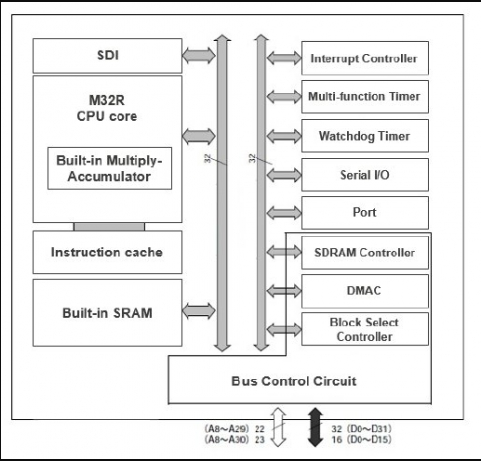
In PC engineering, 32-piece numbers, memory addresses, or other information units are those that are 32 bits (4 octets or 4 Bytes) wide. Likewise, 32-piece CPU and ALU structures are those that depend on registers, address transports, or information transports of that size. 32-piece microcomputers are PCs in which 32-piece chip are the standard. We realize that n-bit microchip can deal with n-bit word size. 


As n-bit register can store 2n various qualities in this way, a 32-piece register can store 232 distinct qualities. The scope of whole number qualities that can be put away in 32 bits relies upon the whole number portrayal utilized. We know there are two most normal portrayals for number information. What's more, they are Unsigned and Signed portrayals. 


The range is 0 through 4,294,967,295 (232 − 1) for portrayal as an Unsigned parallel number, and −2,147,483,648 (−231) through 2,147,483,647 (231 − 1) for portrayal as two's supplement Signed numbers. 

One significant outcome is that a processor with 32-piece memory locations can straightforwardly access all things considered 4 GB of byte-addressable memory. Be that as it may, because of certain issues, however by and by the breaking point might be lower. 


There were various examples of 32-piece microchips. As models, we can think about after 

In 1985, Intel declared the 80386 a 32-piece microchip with 2,75,000 transistors. It upheld performing various tasks. 


Intel 486 chip was the first to offer an inherent math co-processor presented in the year 1989. It had 1.2 million transistors inside it. 

Intel Pentium chip with 3.1 million transistors was presented in the year 1993. It permitted PCs to process true information like discourse, sound, penmanship and photographic pictures. 


In the year 1997, the 7.5-million transistor Intel Pentium II chip was structured explicitly to process sound, video and designs information proficiently. 

In the year 1999, Intel Celeron processors go intended for the worth PC showcase portion were 
discharged.


Intel Pentium IV processors with in excess of 42 million transistors presented from 2000 are utilized in the current PCs. In such PCs, clients can convey TV-like video through the web, speak with continuous video, make proficient quality motion pictures and voice, render 3D illustrations progressively, rapidly encode music for MP3 players and can simultaneously run a few sight and sound applications when the framework is associated with the Internet. 


Presented from 2001, Intel Xeon processors are focused for superior and mid-go, double processor workstations, double and multiprocessor server arrangements coming in the range.


16-bit microprocessors

16-bit microprocessors


16-bit microprocessors


In PC design, 16-piece numbers, memory addresses, or other information units are those that are 16 bits (2 octets or 2 Bytes) wide. Likewise, 16-piece CPU and ALU designs are those that depend on registers, address transports, or information transports of that size. 16-piece microcomputers are PCs in which 16-piece microchips were the standard. 


As n-bit register can store 2n various qualities. So therefore, 16-piece register can store 216 distinct qualities. On the off chance that we consider the marked scope of whole number qualities that can be put away in 16 bits is −32,768 (−1 × 215) through 32,767 (215 − 1). In any case, then again if there should be an occurrence of unsigned range is 0 through 65,535 (216 − 1).


 Since 216 is 65,536, a processor with 16-piece memory locations can straightforwardly get to 216 = × 26 × 210 = 64 x 1024 = 64 x 1K = 64 KB (65,536 bytes) of byte-addressable memory. On the off chance that a framework utilizes division with 16-piece section balances, more can be gotten to. 


In the year 1978, Intel presented the 16-piece microchip 8086 (16-piece transport) and in the year 1979, Intel presented 8088 (8-piece transport). It had 29,000 transistors. In the year 1981, IBM chose the Intel 8088 for their PC (IBM-PC). 


In the year 1982, Intel discharged the 16-piece chip 80286 (having 1,34,000 transistors) to be utilized for the trend setting innovation PCs (PC-AT) as CPU. It was called Intel 286 and was the first Intel processor that could run all the product composed for its antecedent Intel 8088.


 To have the extraordinary business achievement, this retrogressive programming similarity was significant. Note that this product similarity stays a sign of Intel's group of chip.


8-bit microprocessors

8-bit microprocessors


In PC engineering, 8-piece numbers, memory addresses, or other information units are those that are 8 bits (1 octet or 1 Byte) wide. Additionally, 8-piece CPU and ALU structures are those that depend on registers, address transports, or information transports of that size. 8-piece is additionally an age of microcomputers in which 8-piece chip were the standard. Essentially we can consider 8-piece microchip implies 8-piece information or data transport. 


                                                              8-bit microprocessors


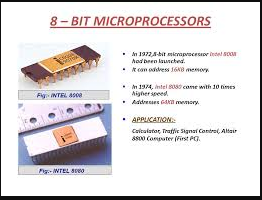
for controlling a CRT show, Federico Faggin and his group at Intel structured a chip delivered by Computer Terminals Corporation. Later this chip was called as Datapoint. This chip didn't meet Datapoint's utilitarian necessity of speed and they chose not to utilize it. World's initial 8-piece broadly useful chip 8008 as created Intel in the year 1972.


 The Intel 8008 was utilized in the well known Mark-8 PC pack. On understanding the capability of this item, Intel presented the improved 8008. What's more, the individual design was known as 8080 microchip in the year 1974.


 The Intel 8080 truly made the microchip showcase. Motorola 6800T is the other eminent 8-piece chip which was intended for use in car and mechanical applications, and Rockwell PPS-8, Signetics 2650. They were having imaginative and incredible guidance set engineering. 


Alongside the enhancements of incorporation advancements, the 8224 clock generator and the 8228 framework controller chips got coordinated and actualized by Intel which was required by the 8080, that is, alongside the 8080 microchip inside a solitary chip – the Intel 8085.


The other improved 8-piece chip incorporate Motorola MC6809 intended for superior, Zilog Z-80 and RCA COSMAC structured. This was structured and produced for aviation applications. 


8-bit microprocessors


Forecasts by Moore, in the year 1975, towards exponential development in the multifaceted nature of incorporated circuits was valid. He additionally did the gauge of a change for the following decade showing that the pace of unpredictability increment would ease back to a multiplying like clockwork during the development of plan abilities.


Chip overwhelmed as the CPU of advanced PCs similarly as with the expansion in handling power. Prior to the appearance of microchips, CPU was acknowledged from individual SSI chips. As a meaning of a microcomputer, we can express that it is a computerized PC that utilizes a solitary chip microchip as its CPU.


Microprocessor Architecture & Its Operations

Microprocessor Architecture & Its Operations

A microchip is the focal handling unit (CPU) of a PC. It is the place preparing of program guidelines and information happens. An essential PC comprises of a chip, outside memory, and information and yield gadgets. 


Design of a Simple Microprocessor 


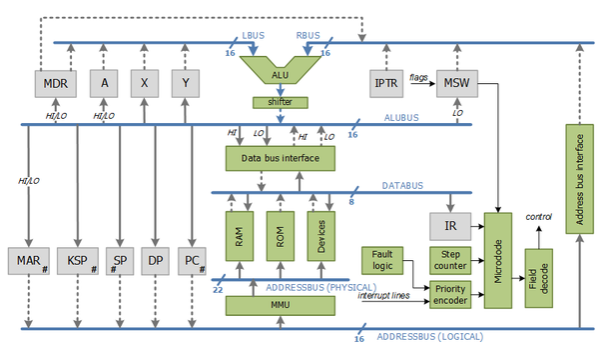
The accompanying segments portray the fundamental parts of a straightforward chip design. It is nearer to early microchips. In any case, it is as yet the establishment of the present progressively complex chip


Arithmatic and Logic Unit 

Number juggling and rationale tasks occur in the ALU. 

Aggregator 

The Accumulator holds one of the operands just as the outcome in tasks performed by the ALU. 

Program Counter (PC) 

The program counter contains the memory address of the following project guidance to be executed. 

Address, Data and Status Registers and Stack Pointer 

The Address Register contains address of a memory area to be gotten to. 

The Data Register contains the information originating from or going to memory or an I/O port. 

The Status Register contains data about the aftereffect of the past ALU activity. 

The Stack Pointer register contains the location of the square of memory (the stack) where subroutine return addresses are put away. 


Control unit 


The Control Unit contains the hardware that controls the way toward bringing, deciphering and executing program guidelines. 

Essential Components of Microprocessors 

Intel presented the main microchip in 1971 and considered it the 4004 chip. The present chip, with measurements littler than a dime, offer more force and capacities. The focal point of the PC, the focal handling unit (CPU) comprises of at least one chip. Made from a silicone chip that contains a great many transistors, microchips move information starting with one memory address then onto the next area. The CPUs settle on choices and afterward proceed onward to take a shot at new directions and computations. 


Arithmatic and Logic Unit 


The "number juggling and rationale unit" (ALU) performs math calculations, for example, deduction, expansion, division and Boolean capacities. Boolean capacities are a kind of rationale utilized for circuit structures. The ALU likewise executes correlations and rationale testing. The processor transmits signs to the ALU, which deciphers the directions and plays out the counts. 


Registers 


Microchips have transitory information holding places called registers. These memory regions look after information, for example, PC guidelines, stockpiling locations, characters and other information. Some PC guidelines may require the utilization of specific registers as a major aspect of an order. Each register has a particular capacity, for example, guidance register, program counter, collector and memory address register. For instance, a program register holds the location of guidelines taken from arbitrary access memory. 


Control Unit 


Control units (CUs) get signals from the CPU, which teaches the control unit to move information from chip to microchip. The control unit additionally coordinates the number-crunching and rationale unit. Control units comprise of various segments, for example, decoder, clock and control rationale circuits. Cooperating, these gadgets transmit signs to specific areas on the microchip. 

For instance, the decoder gets orders from an application. The decoder deciphers the directions and makes a move. It imparts signs to the ALU or guides registers to perform explicit assignments. The control rationale unit transmits signs to various segments of the microchip and registers, which illuminates these parts to execute activities. The clock imparts signs that synchronize and guarantee ideal execution of orders and procedures 


Transports 


Microchips have an arrangement of transports, which move information. Transports allude to orders of wiring that have explicit undertakings and capacities. The information transport moves information between the focal preparing unit and arbitrary access memory (RAM) - the PC's essential memory. The control transport sends data important to arrange and control various assignments. The location transport transmits the location between the CPU and the RAM for information being prepared. 


Store Memory 


Some propelled microchips have memory stores, which hold the last information utilized by the CPU. Memory reserves accelerate the figuring procedure, in light of the fact that the CPU doesn't need to go to the more slow RAM to recover information. Numerous PCs have level 1 or level 2 stores; a few frameworks have level 3 reserves. The reserve level demonstrates the request wherein the CPU checks for information, beginning with level 1. Producers regularly incorporate level 2 and level 3 stores into the microchip, which upgrades handling speed..